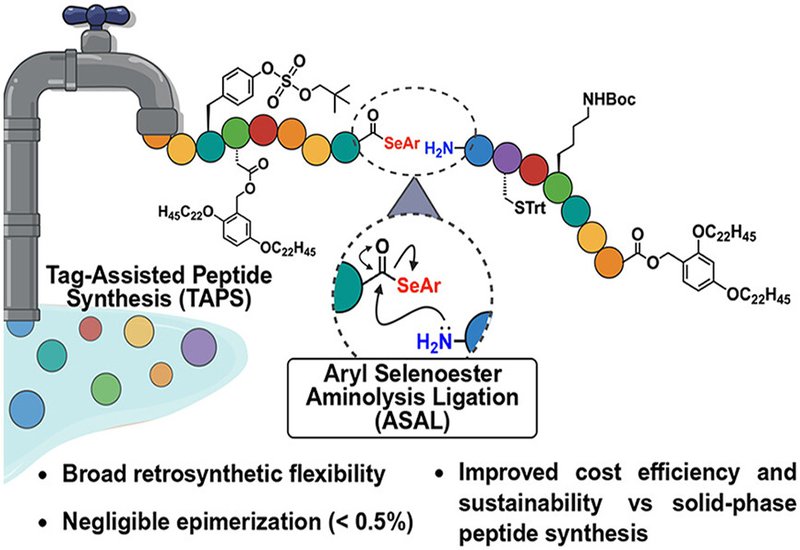
Solid-phase peptide synthesis, SPPS, built the modern peptide therapeutics industry, yet its environmental and practical shortcomings have become harder to ignore as blockbuster GLP-1 agonists push manufacturing demand to unprecedented levels. SPPS requires superstoichiometric amino acid and reagent excesses, repeated washes with toxic and carcinogenic solvents, and becomes unreliable for sequences beyond roughly 50 residues. Tag-assisted peptide synthesis, TAPS, addressed the reagent-excess problem by tethering the growing chain to a lipophilic support that precipitates after each coupling, slashing solvent waste and enabling near-stoichiometric conditions. Even so, TAPS had never been extended reliably beyond 20 residues, confining it to shorter fragments rather than full-length therapeutics.
Researchers in the Payne Group at The University of Sydney, in collaboration with researchers at Novo Nordisk A/S, and Colorado State University, published in J. Am. Chem. Soc., developed aryl selenoester aminolysis ligation, ASAL, as a fragment-fusion strategy that couples side-chain-protected, tag-bearing peptides prepared by TAPS. The team first optimized TAPS coupling cycles using the green solvent system 2-MeTHF/DMSO with COMU as a coupling reagent, replacing the conventional MeCN precipitation step with acidic brine washes to remove excess base and reagents at each cycle. Aryl selenoesters were then generated on the C-terminal carboxylic acid of one fragment by treatment with tri-n-butylphosphine and diphenyldiselenide in cyclopentylmethyl ether, and ligations were performed by dissolving both fragments in N-butylpyrrolidinone, NBP, at 37 °C.
Screening across a matrix of C-terminal amino acids, including sterically hindered and historically epimerization-prone residues, showed that ASAL proceeded with good to excellent conversions in most cases as judged by UPLC analysis. Critically, epimerization at the ligation junction was below 0.5% for the majority of junctions, compared with 16–33% epimerization observed under fragment condensation conditions using EDC, HATU, or PyBOP as coupling reagents. Density functional theory calculations rationalized this result: the energy barrier for oxazolone formation, a primary epimerization pathway, is 21.9 kcal/mol for aryl selenoesters compared with 16.1–19.9 kcal/mol for the common active ester intermediates. The greater than 30-fold slower rate of oxazolone formation keeps the chiral center intact while the selenium-activated carbonyl reacts rapidly with the incoming amine through favorable orbital overlap.
With the mechanistic basis established, the team applied the combined TAPS-ASAL platform to three therapeutic targets of increasing complexity. Teriparatide, the 34-residue osteoporosis drug, was assembled from two TAPS-derived fragments via a single ASAL step and isolated in 23% yield over 38 linear steps with only one HPLC purification. Doubly sulfated tsetse thrombin inhibitor, sY-TTI, a 32-residue anticoagulant bearing acid-labile sulfotyrosine post-translational modifications at positions 9 and 12, required a modified TAPS protocol to protect the neopentyl sulfate ester during scavenging; the final peptide was obtained in 9% yield over 39 linear steps with no detectable epimerization. A process mass intensity, PMI, comparison with an SPPS route showed approximately a 3-fold reduction for the TAPS-ASAL synthesis, primarily from eliminating DMF washing steps. Tirzepatide, the 39-residue GIP/GLP-1 receptor agonist bearing two 2-aminoisobutyric acid residues and a lipidated lysine side chain, required a three-fragment, two-ligation sequence completed without intermediate purification, delivering the target in 27% yield over 38 linear steps.
By uniting the reagent efficiency of TAPS with the stereochemical fidelity and junction flexibility of aryl selenoester ligation, ASAL removes the principal barriers that have kept liquid-phase peptide synthesis at the margins of pharmaceutical manufacturing. The approach accommodates post-translational modifications, lipid conjugates, and non-canonical residues, requires only a single chromatographic purification across an entire multifragment synthesis, and operates in solvents with favorable environmental profiles. The authors anticipate broad adoption of the TAPS-ASAL platform across academic and industrial settings where increasing synthetic efficiency and reducing environmental impact are both priorities.